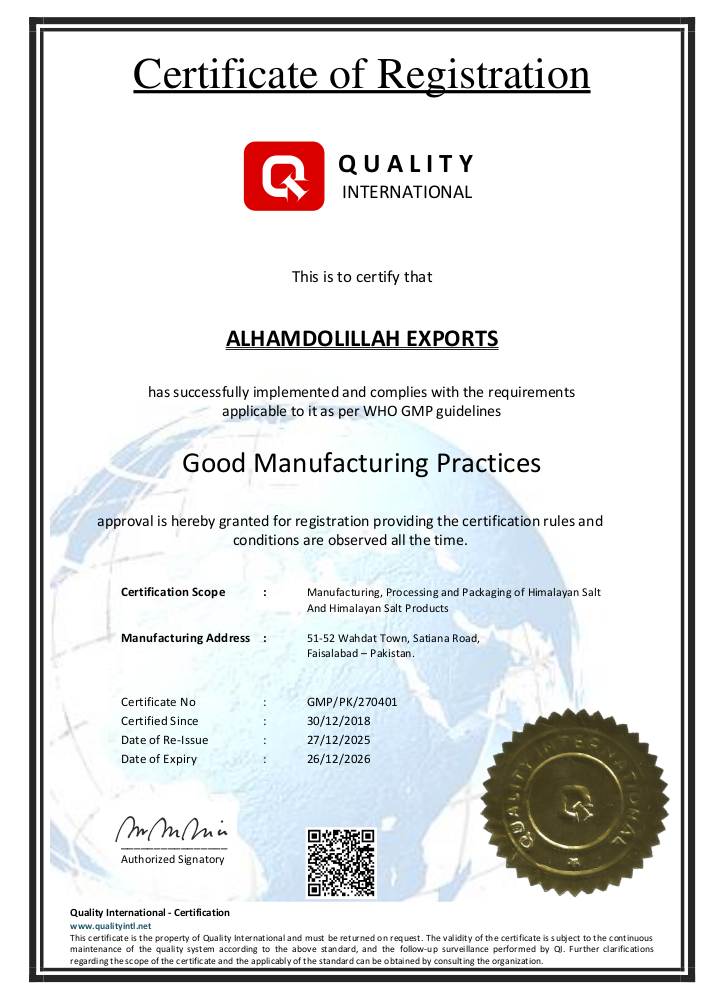
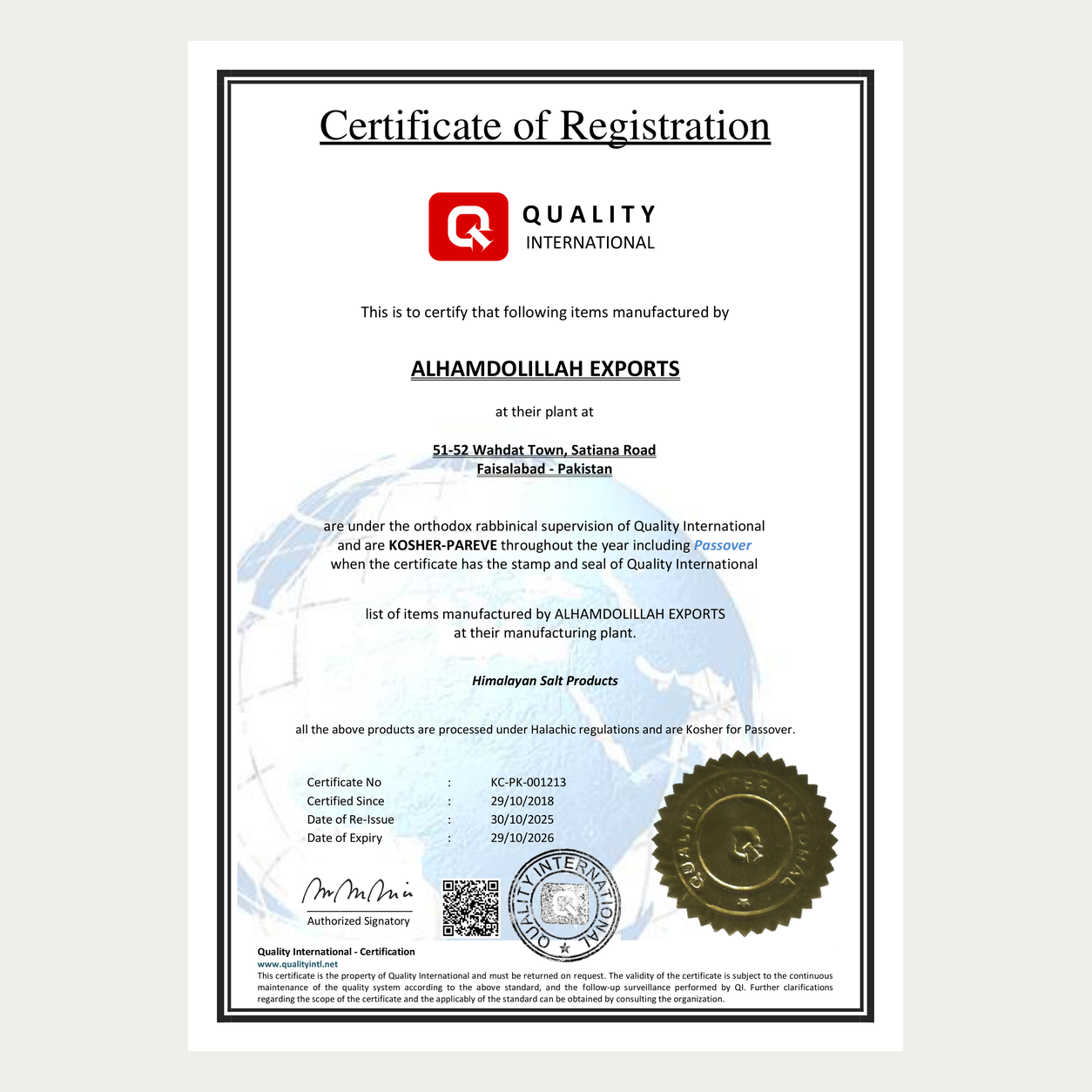
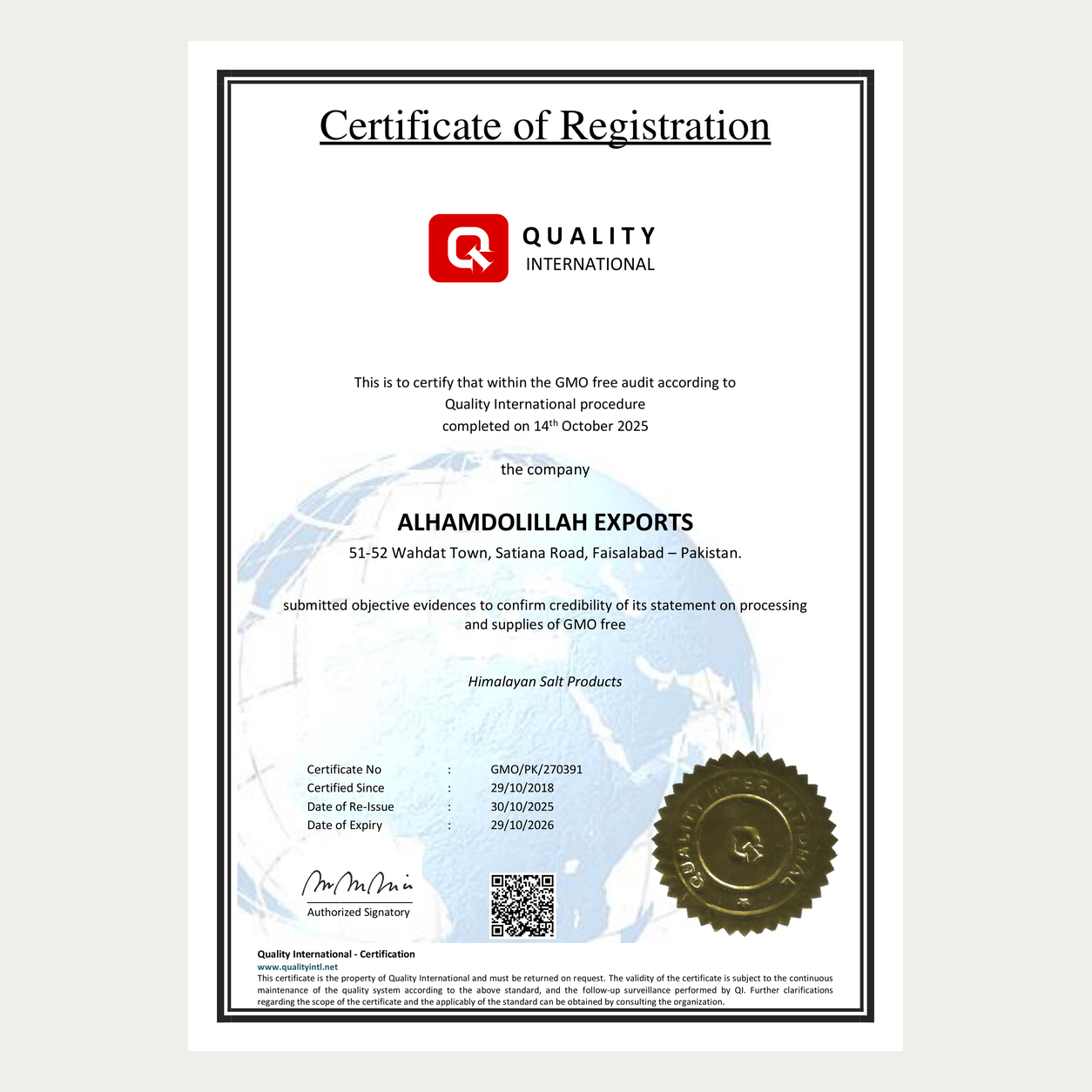
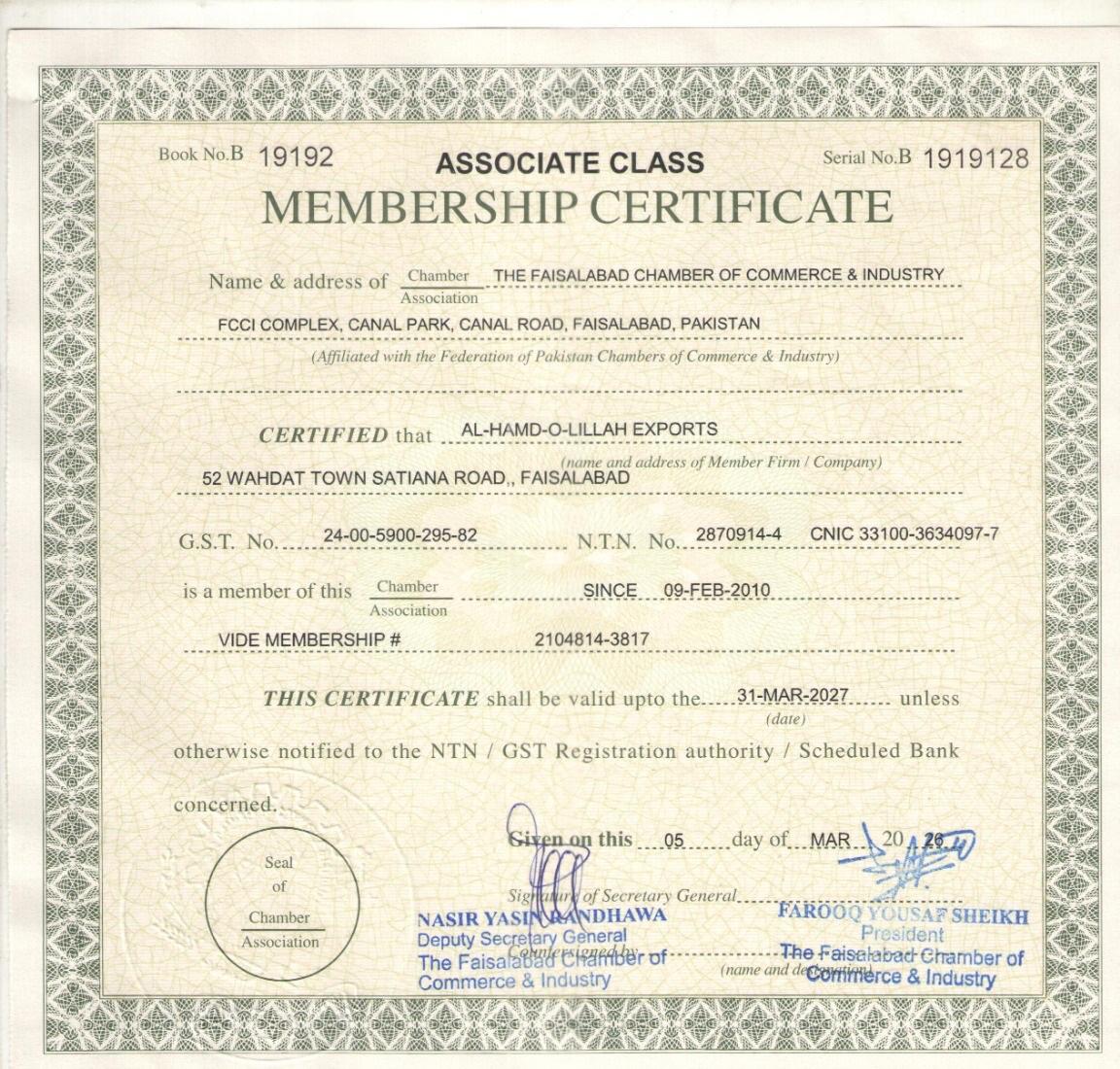
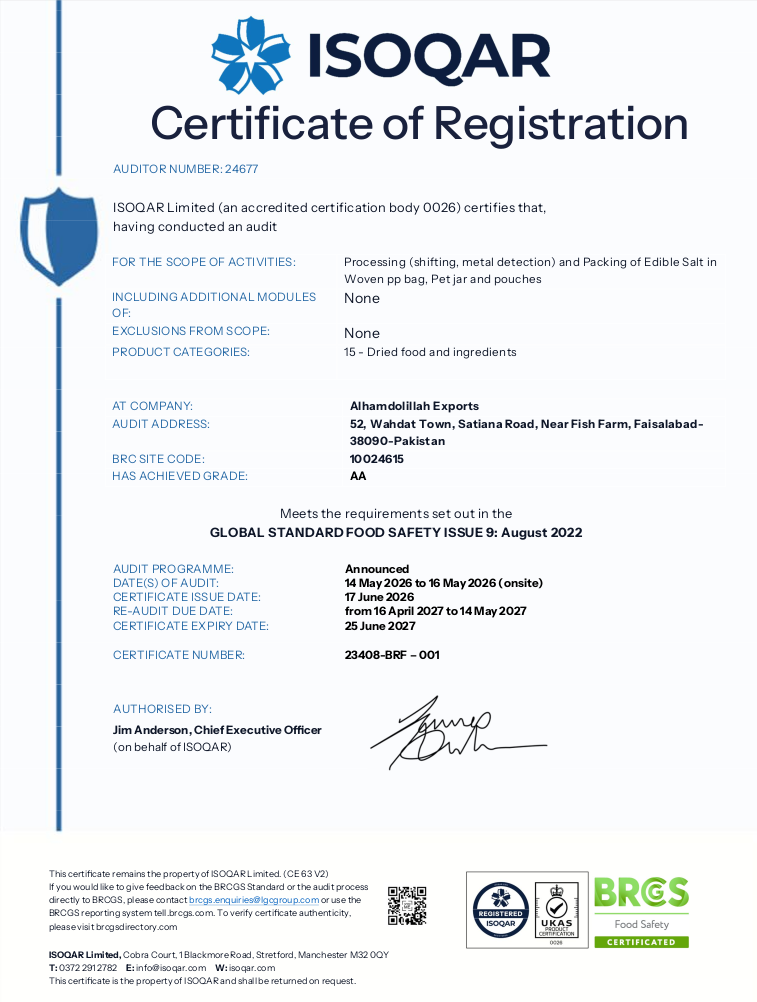
We hold BRCGS Global Standard Food Safety certification at Issue 9, Grade AA — the highest rating the standard awards. Certificate number 23408-BRF-001, issued by ISOQAR Limited against BRC site code 10024615, valid through June 2027, and independently verifiable on the BRCGS public directory. We are also a United Nations registered vendor. Every certification below is listed with its issuing body, its reference number, and what it means for entry into your market.
For any buyer purchasing salt as a food ingredient, certification is not a differentiator between suppliers. It is the gate that decides which suppliers get considered at all. A retailer’s supplier approval process, a food manufacturer’s due diligence file, and a customs authority’s import clearance each ask the same question in different language: can this producer evidence that its product is safe, traceable, and made under an audited system.
Most Himalayan salt on the international market is sold by traders rather than producers, and a trader cannot answer that question about a facility it does not operate. What it can supply is a certificate belonging to someone else, or a specification sheet with no audited system behind it. That works until the buyer’s auditor asks to see the chain of custody, at which point the supply relationship usually ends. We hold certification in our own name, for our own facility, and every document referenced on this page is verifiable against the issuing body rather than against our word for it.
Grade AA is the highest achievable BRCGS rating. Satisfies supplier-approval for major retailers in EU, UK, North America, Gulf and Australasia.
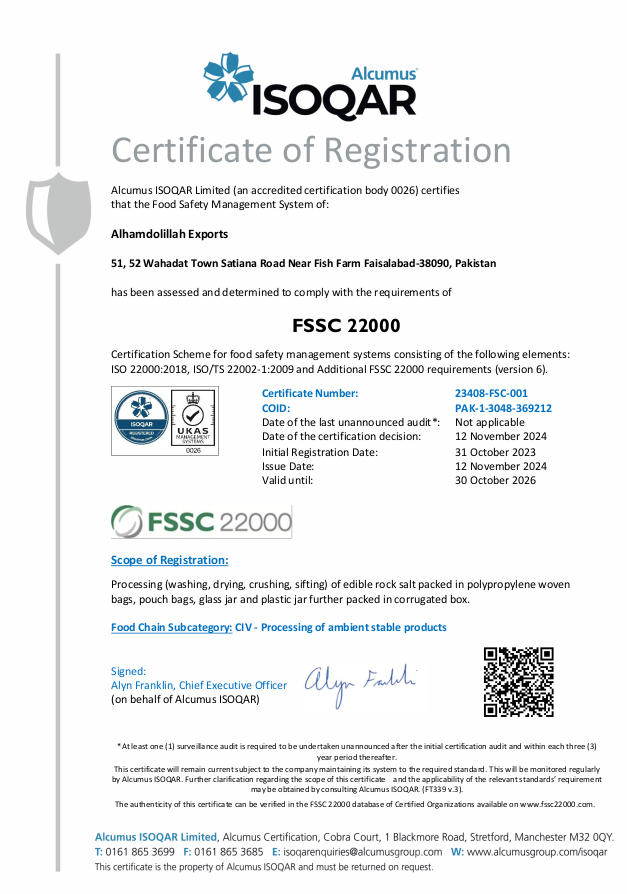
GFSI-recognised scheme covering ISO 22000:2018 and ISO/TS 22002-1:2009. Satisfies major retailer and food manufacturer supplier-approval requirements globally.
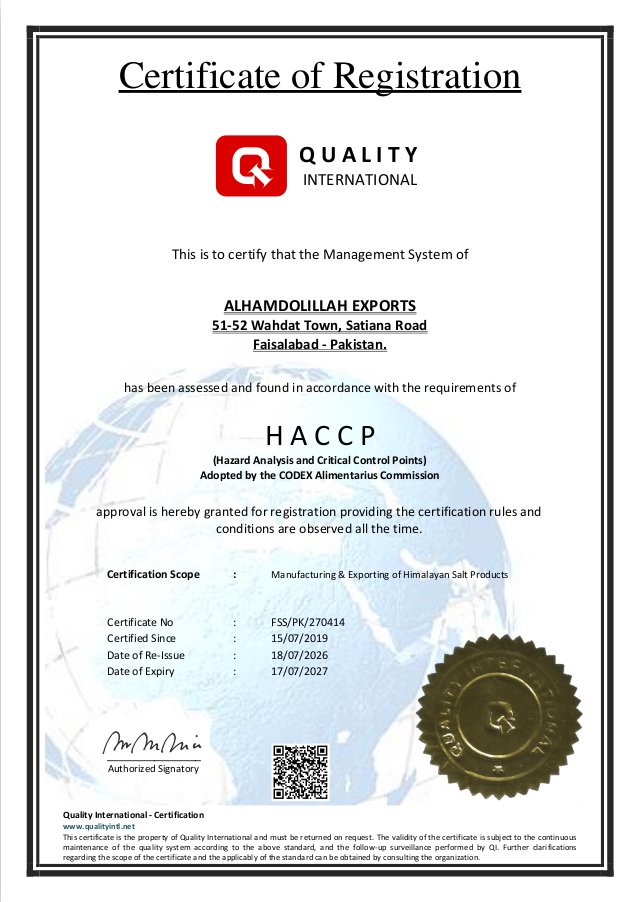
International food safety standard covering hazard analysis at every critical control point. Recognised by food manufacturers and regulators across all export markets.
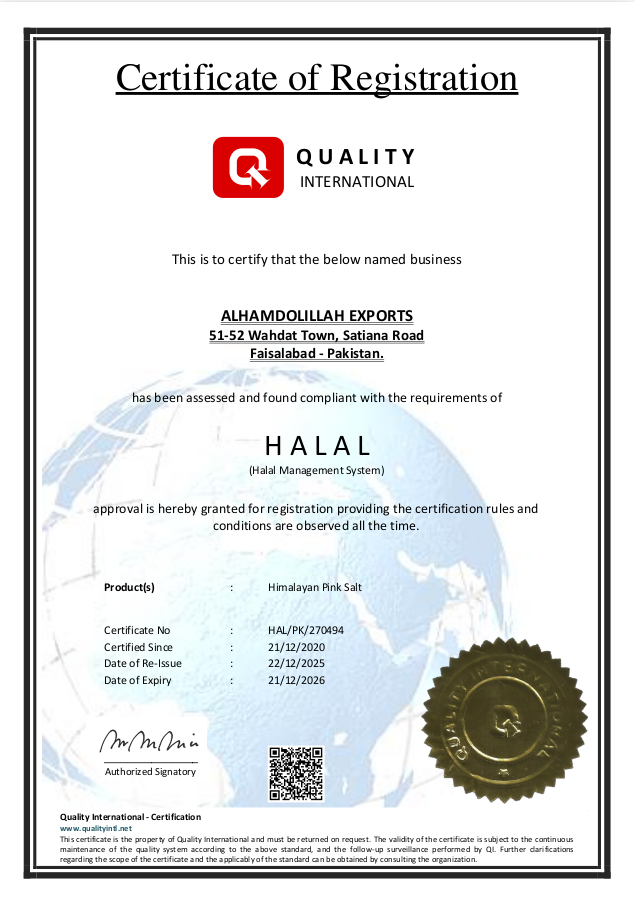
Halal certification for Himalayan Pink Salt. Required for Gulf, Middle East, Southeast Asia, and supply to halal-certified food manufacturers worldwide.
WHO GMP compliance for manufacturing, processing and packaging. Required by cosmetic distributors, pharmaceutical-grade buyers and health product retailers.
Opens access to kosher-observant markets in the USA, EU and Israel. Required by retailers and distributors serving Jewish consumer communities worldwide.
Third-party verified GMO-free status. Required by natural food retailers and organic brands in EU, USA and Australia.
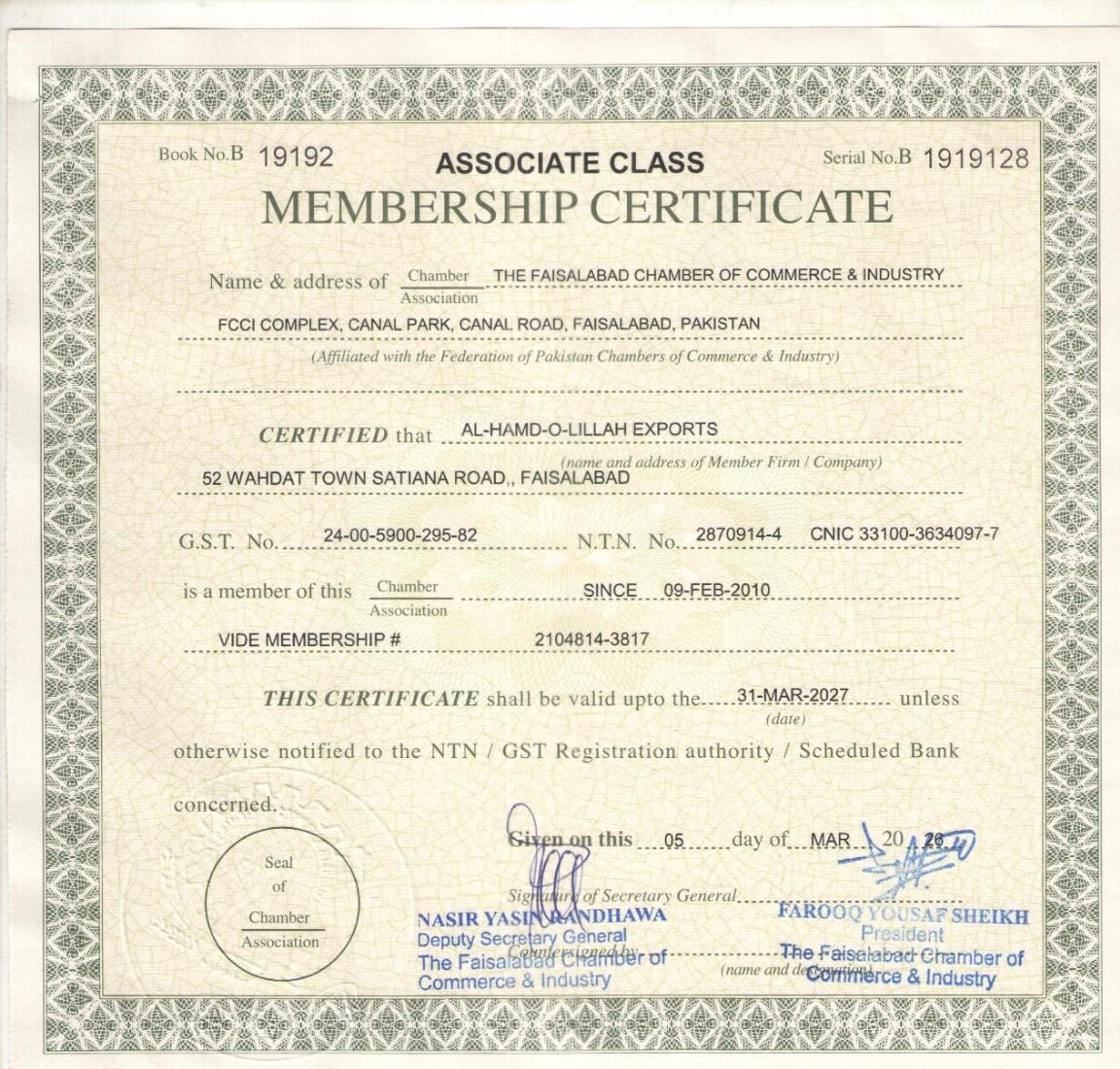
Registered member of the Faisalabad Chamber of Commerce & Industry, affiliated with the Federation of Pakistan Chambers. Confirms legitimate registered export business standing.
Eligibility to supply UN agencies and procurement programmes. Independent verification of business standing recognised by institutional and government buyers worldwide.
BRCGS is an unannounced or scheduled third-party audit of an entire production site against a published standard, not a certificate issued against a paper submission. Issue 9 is the current version of the Global Standard for Food Safety. Grades run from AA down through A, B, C, and D, determined by the number and severity of non-conformities found during the audit, and Grade AA requires the fewest.
We would rather you checked than took our word for it. Our BRCGS certification is listed on the BRCGS public directory and searchable by site code or certificate number. Search site code 10024615 or certificate 23408-BRF-001 at brcgsdirectory.com and the record will show the certificated site, the standard and issue, the grade, the certification body, and the current validity status.
If you are completing a supplier approval file and need the certificate itself, the audit report summary, or a completed supplier questionnaire, ask and we will send them the same working day. We would also rather you asked early. Discovering at the purchase order stage that a document is missing costs everyone a fortnight, and the documentation exists precisely so it can be handed over before it becomes urgent.
Certification is the system. Documentation is what proves a specific container came out of it. Every shipment leaves with its paperwork prepared in advance rather than assembled after a buyer asks, because the question always comes and it always comes at the least convenient moment.
Standard documentation includes a certificate of analysis referenced to the production lot in your container, a certificate of origin, a packing list and commercial invoice, and the BRCGS certificate. Depending on your destination and product, we also prepare phytosanitary certificates, health certificates, Halal certification, INCI statements and safety data sheets for cosmetic-grade products, veterinary and feed-import documentation for animal licks, and the market-specific registration paperwork your customs authority requires.
Tell us the destination market at the quotation stage and we will confirm exactly which documents your import will need, before the container is booked rather than while it sits at a port.
WhatsApp us